The Duke and Duchess's Altisidora Resurrection Prank
Don QuixoteThe Duke and Duchess’s Altisidora Resurrection Prank transforms a supposed death into a courtly spectacle designed to make Sancho Panza suffer and Don Quixote believe in a miracle. In the castle court, a theatrically elaborate funeral gives way to a mock resurrection, while Sancho is told that his ordeal will restore Altisidora to life. The scene’s reversal is both comic and revealing: the hosts manufacture the marvel, but their performance makes the two travelers’ credulity and discomfort part of the entertainment.
The Plot Behind the Spectacle
The immediate occasion is Don Quixote and Sancho’s return journey. The explanation supplied afterward by Cide Hamete Benengeli connects the prank to a longer effort by Samson Carrasco to end Don Quixote’s travels. Carrasco had previously been defeated while disguised as the Knight of the Mirrors; after learning where Don Quixote was, he armed himself anew and later met him as the Knight of the White Moon. The terms of that encounter required Don Quixote, once defeated, to return to his village and remain there for a year. Carrasco hoped the enforced retreat might help cure what he regarded as Don Quixote’s madness.
Carrasco told the Duke about the encounter and about the earlier jokes played on Don Quixote and Sancho, including the supposed disenchantment of Dulcinea at Sancho’s expense. The Duke then arranged a further deception. Servants were posted along the roads where the travelers might pass, with orders to bring them to the castle by fair means or foul. When they found them, the Duke had the court prepared and Altisidora placed as if dead. The apparent ceremony is therefore not an accidental misunderstanding: it is a performance organized by the hosts after they have learned the travelers’ circumstances and vulnerabilities.
A Funeral Made into a Court Performance
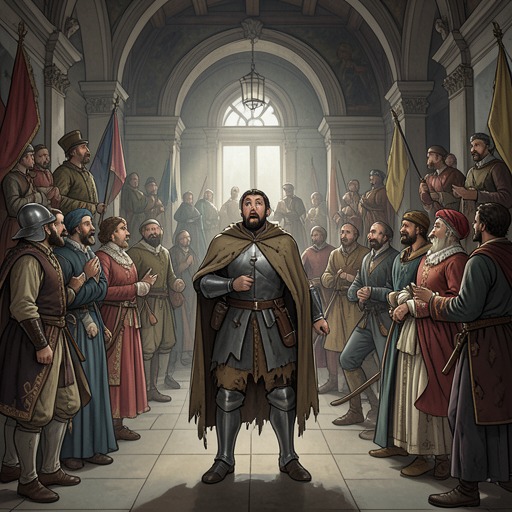
The travelers are carried into a court illuminated by nearly a hundred torches and more than five hundred lamps. At its center stands a raised catafalque beneath black velvet, surrounded by white candles in silver holders. Altisidora lies upon it with flowers on her head and a palm branch between her crossed hands. The arrangement makes the scene look solemn and ceremonial, while its excess—the brilliant lighting, elaborate staging, and silent assembly—signals that the court has become a theatre.
The Duke and Duchess appear beside two figures presented as kings, who are identified as Minos and Rhadamanthus, judges of the underworld. Don Quixote recognizes his hosts, but the assembled company’s performance leaves both travelers silent with amazement. Sancho is dressed in a black robe painted with flames and given a mitre, as if he were undergoing a religious sentence. The disguise turns him into a visible part of the pageant before he has agreed to take part in its supposed cure.
A young singer appears beside the catafalque and performs a lament praising Altisidora. Minos interrupts to insist that the song give way to the practical business of restoring her. Rhadamanthus then declares that the restoration depends on Sancho enduring a series of humiliating physical attentions. The supernatural language supplies a mock explanation for the ceremony, but the scene’s real mechanism is social pressure: authority figures, attendants, music, and a watching court all combine to make Sancho’s participation appear necessary.
Sancho’s Resistance and the Reversal
Sancho challenges the supposed remedy. He contrasts the demand that he be tormented to restore Altisidora with the separate demand that he whip himself to disenchant Dulcinea, and protests that he is being made to bear the cost of other people’s troubles. His objection is practical as well as comic: he sees no connection between his treatment and Altisidora’s condition. He is especially unwilling to let the duennas touch him, though he eventually presents himself for the first part of the ritual after Don Quixote urges him to be patient and to help restore the dead.
The duennas and other members of the household carry out the staged requirements. Sancho accepts some of the imposed indignities, but when the proceedings continue he loses patience, rises, and takes up a lighted torch to drive his tormentors away. At that instant, Altisidora turns onto her side. The court cries out that she is alive, and Rhadamanthus tells Sancho that the object has been attained. The timing converts Sancho’s protest into the apparent final step of a miracle: the moment he breaks away is also the moment the staged death ends.
Don Quixote immediately treats Altisidora’s movement as proof of Sancho’s extraordinary virtue and tries to turn the occasion toward the still-unfulfilled disenchantment of Dulcinea. Sancho refuses to accept another demand after what he has just endured, insisting that he is tired of being made responsible for curing other people. His response preserves the difference between the master’s chivalric interpretation and the squire’s bodily, material reckoning with the performance.
Aftermath and Meaning
Altisidora sits up, and the court receives her with a ceremonial display of music and acclamation. She thanks Don Quixote in a manner that continues the fiction that his cruelty caused her death, then offers Sancho six clean smocks. Sancho kneels to receive the gift. He also asks to keep the robe and mitre as mementos of the adventure; the Duchess agrees, and the Duke orders the court cleared and the travelers returned to their quarters. The episode thus leaves Sancho with both a token of the spectacle and a material reward, even though neither changes the fact that he has been made its principal target.
The next-day account by Cide Hamete Benengeli discloses that Altisidora was following the Duke and Duchess’s joke, not returning from death. The elaborate staging was planned after Carrasco had described the travelers’ situation, and the servants’ interception brought them to a performance already prepared. The narrator judges the prank’s makers little less foolish than its victims: the Duke and Duchess take such pains to mock Don Quixote and Sancho that their own conduct becomes part of the satire.
The prank also exposes how easily theatrical authority can lend a false claim the appearance of truth. Costumes, titles, ritual gestures, music, and a crowd turn an invented cure into a command that Sancho is expected to obey. Don Quixote reads the spectacle through the logic of enchantment and heroic service; Sancho keeps testing it against the unfair demands made of him. By making the supposed resurrection depend on Sancho’s suffering, the Duke and Duchess turn his established role in the Dulcinea enchantment plot into a fresh mechanism of amusement, while revealing the cruelty beneath their polished hospitality.